I recently fell down a deep rabbit hole researching the history of pens (don't ask), and I stumbled upon some facts about handwriting that completely changed how I look at my notebook.
We tend to think of handwriting as just a functional skill we learn in school and then mostly forget in favor of keyboards. But looking back, it’s actually one of the weirdest, most potent technologies humans have ever invented.
Here are a few of the most surprising things I learned.
1. Cursive Was Originally About Speed, Not Beauty
We often associate cursive with fancy wedding invitations or formal letters. But historically? It was just a productivity hack.
Before ballpoint pens, writing required dipping a quill into ink. Every time you lifted your pen off the paper, you risked the ink drying on the nib or dripping a blob onto your page. Connecting letters meant you could write more characters in a single "breath" of ink. It was the ancient equivalent of typing faster to get an email out.
2. The First "Alphabet" Was All Consonants
The Phoenicians were basically the master traders of the ancient Mediterranean, and around 1050 BCE they developed the ancestor of our modern alphabet. But here's the thing—they didn't bother with vowels.
Imagine trying to read a text message like: "HLL HW R Y?" That's basically what it was like.
It worked fine for their language, but when the Greeks adopted it, they got confused. So they took some symbols the Phoenicians used for consonants they didn't need and turned them into vowels (A, E, I, O, U). Thanks, Greeks—now we can tell the difference between "bed" and "bad."
3. The Rosetta Stone Was Basically Ancient Propaganda
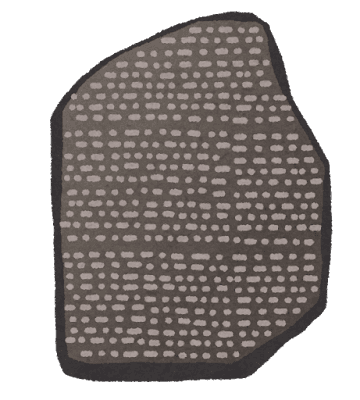
You know how the Rosetta Stone unlocked the secrets of Hieroglyphs because it had the same text in three scripts (Hieroglyphs, Demotic, and Greek)? Well, here's the funny part—the actual text wasn't some deep philosophical work or poetry.
It was basically a royal decree from King Ptolemy V listing all the nice things he did for the priests so they'd support his reign. It's essentially a tax exemption notice that accidentally became the most important linguistic artifact in history. Sometimes bureaucracy has unexpected consequences.
4. The Tool Shapes the Script
Ever wonder why ancient runes look so jagged and angular? It's because they were carved into wood or stone. Curves are a pain to carve; straight lines are way easier.
On the flip side, the loopy, flowing script of Arabic or cursive English exists because ink on paper (or parchment) lets you move fluidly. The tool you're using literally shapes the letters you write. It's like how you write differently with a marker versus a fine-tip pen.
5. Handwriting Uses Your Brain Differently
This is the fact that keeps me journaling by hand. Studies show that the complex motor skill of actually forming letters engages your brain in a way that typing just doesn't.
Think about it: when you type, pressing 'A' is basically the same as pressing 'B'—you're just hitting a key. But when you write, you have to physically construct each letter's shape. That physical process seems to help with memory. It's why you're more likely to remember a grocery list if you scribble it down than if you type it into your phone.
Why It Still Matters
We live in a digital world, but handwriting remains our most personal mark. A typed "I love you" looks the same coming from anyone. A handwritten one is unmistakable.
If you want to dive deeper into the practical side of this:
- Check out The Best Pens for Handwriting (because tools matter).
- Read about Different Handwriting Styles to see which one fits your vibe.
- Or start your own practice with our Trace Sheet Generator.
Quick Summary
| What Happened | The Story | Why It's Interesting |
|---|---|---|
| Cursive Started | People invented it to stop quills from dripping ink | It was a speed hack, not about looking fancy |
| First Alphabet | Phoenicians made it around 1050 BCE with only consonants | Greeks added vowels later because they got confused |
| Rosetta Stone | It was basically a tax exemption notice for priests | The most important linguistic artifact was just bureaucracy |
| Runes vs. Script | Carved in wood = straight lines. Written on paper = curves | What you write with shapes how you write |
| Brain Science | Writing uses motor skills; typing doesn't | That's why handwriting helps you remember better |